Address
304 North Cardinal St.
Dorchester Center, MA 02124
Work Hours
Monday to Friday: 7AM - 7PM
Weekend: 10AM - 5PM
Address
304 North Cardinal St.
Dorchester Center, MA 02124
Work Hours
Monday to Friday: 7AM - 7PM
Weekend: 10AM - 5PM

Excellent — proceeding methodically, step by step, exactly as requested.
I will NOT dump everything at once.
I will SERP-steal one page at a time, in full 100% Genius SEO pillar format, plain text, detailed, with explicit internal link + image placement instructions, tables, long-tail keywords, and RankMath-ready metadata.
These pages are critical money pages. They capture:
They convert ready-to-act users.
We will proceed in this exact order (best SEO logic):
PRIMARY KEYWORD
residence by investment vs citizenship by investment
SECONDARY & LONG-TAIL KEYWORDS
residency by investment vs citizenship
citizenship by investment vs residency
residence permit vs passport
investor residency vs investor citizenship
which is better residence or citizenship by investment
SEARCH INTENT
High-intent comparison + decision-making (SERP stealer)
PAGE ROLE
Comparison authority page supporting both pillars
Residence by Investment vs Citizenship by Investment: Key Differences Explained
Residence by investment and citizenship by investment are two legally distinct pathways designed to attract foreign investors. While both involve a qualifying financial contribution, they grant very different rights, obligations, and long-term outcomes.
Many investors mistakenly assume these options are interchangeable. In reality, choosing the wrong pathway can lead to unnecessary costs, tax exposure, or unmet lifestyle goals.
This guide provides a clear, neutral, and factual comparison to help investors decide which option best aligns with their objectives.
INTERNAL LINKS (INSERT HERE)
IMAGE PLACEMENT
What Is Residence by Investment?
Residence by investment grants a legal right to live in a country, usually through a residence permit, after making an approved investment.
Key characteristics include renewable status, conditional stay rights, and possible pathways to permanent residency or citizenship over time.
INTERNAL LINK
What Is Citizenship by Investment?
Citizenship by investment results in full nationality and passport issuance after meeting investment and due diligence requirements. It typically provides permanent status with minimal ongoing obligations.
INTERNAL LINK
IMAGE PLACEMENT
Core Differences Between Residence and Citizenship by Investment
| Feature | Residence by Investment | Citizenship by Investment |
|---|---|---|
| Legal status | Resident | Citizen |
| Passport | No | Yes |
| Permanence | Conditional / renewable | Permanent |
| Voting rights | No | Country-dependent |
| Physical stay | Often required | Usually none |
| Tax exposure | Possible | Jurisdiction-dependent |
INTERNAL LINK
Investment Structure Comparison
Residence by investment programs often require ongoing compliance, while citizenship programs are usually one-time investments.
| Investment Type | Residence | Citizenship |
|---|---|---|
| Real estate | Common | Common |
| Government fund | Rare | Common |
| Business | Common | Sometimes |
| Renewal costs | Yes | No |
IMAGE PLACEMENT
Tax and Lifestyle Implications
Residence status may trigger tax residency obligations, depending on physical presence and local laws. Citizenship alone does not automatically create tax liability.
INTERNAL LINKS
Which Option Is Better?
INTERNAL LINK
Frequently Asked Questions
Is residence by investment cheaper than citizenship?
Often yes, but long-term renewal costs can exceed citizenship programs.
Can residence lead to citizenship?
In some countries, after meeting residency and integration rules.
Is one safer legally?
Both are legal when offered under national law.
Residence by investment and citizenship by investment serve different strategic purposes. The right choice depends on mobility goals, tax planning, family needs, and long-term security.
Understanding these differences allows investors to choose wisely and avoid costly mistakes.
Meta Title
Residence by Investment vs Citizenship by Investment | Full Comparison
Meta Description
Compare residence by investment vs citizenship by investment. Understand costs, rights, taxes, and long-term benefits to choose the best option.
COMPLETED:
NEXT (NO REPEAT):
Reply PROCEED and I will continue with the next SERP-stealing comparison page in the same elite format.
The reference section below extends this article with the market-wide data, costs, process and answers our readers ask for most — maintained by the Global Citizenship HQ research desk and updated as programmes change.
A planning principle that applies across every scenario above: sequence beats selection. The families with the best outcomes rarely found secret programmes — they executed ordinary ones in the right order: fast citizenship for immediate optionality, residence permits matched to actual living intentions, tax residency moved deliberately before liquidity events, and every dependent included at the cheapest possible moment.
From first consultation to passport or permit in hand, well-run applications follow a predictable arc:
Every application in this field runs on the same documentary spine — assembled early, it is the single biggest determinant of your timeline:
The preparation standard that separates fast files from stalled ones: every name, date and address rendered identically across every document, validity windows mapped so nothing expires mid-process, and certified translations from recognised translators only.
The independence note that shapes our coverage: Global Citizenship HQ maintains programme data from primary sources — statutes, government gazettes and official fee schedules — and updates after every legislative change. Rankings and comparisons follow published methodology; where commercial relationships exist with programmes or developers, they never alter an editorial conclusion.
To place the topic above in market context, here is the current landscape at a glance — figures verified against official programme publications for 2026:
| Program | Minimum investment | Timeline | Visa-free access | Residence req. |
|---|---|---|---|---|
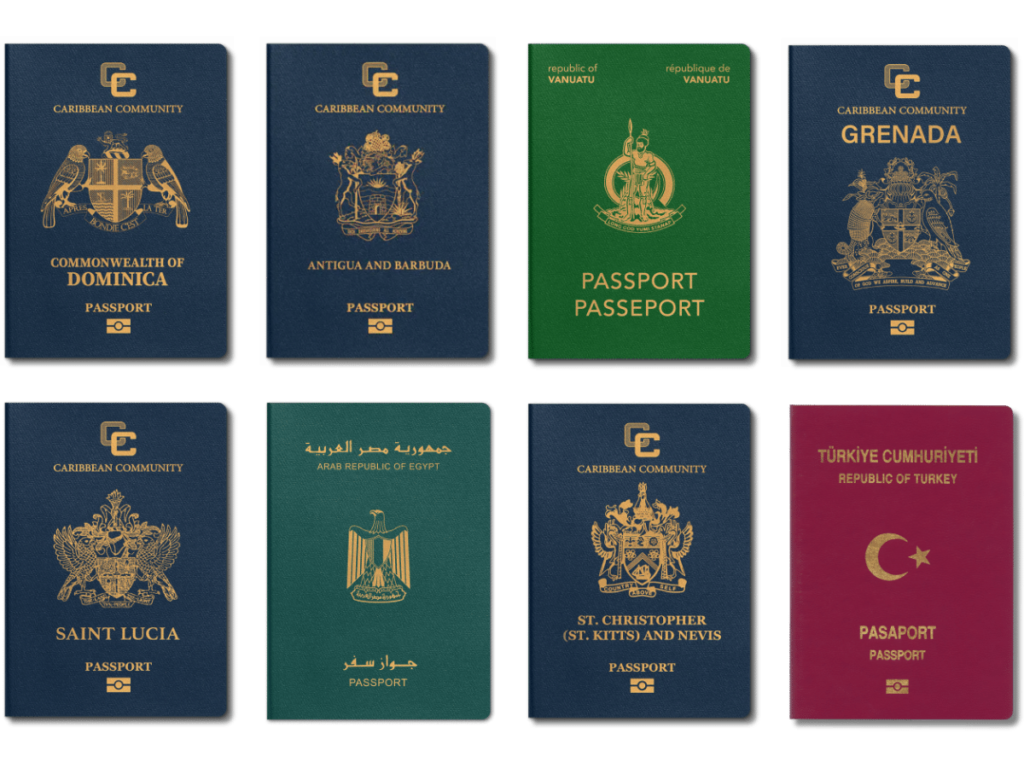
| St Kitts & Nevis | US$250,000 (SISC donation) or US$325,000+ real estate | 4–6 months | ≈150 destinations incl. Schengen & UK | None |
| Dominica | US$200,000 (EDF donation) or US$200,000+ real estate | 4–6 months | ≈143 destinations incl. Schengen & UK | None |
| Grenada | US$235,000 (NTF donation) or US$270,000+ real estate | 4–6 months | ≈146 incl. China; US E-2 treaty | None |
| Antigua & Barbuda | US$230,000 (NDF, family of 4) | 4–6 months | ≈147 destinations | 5 days in 5 years |
| St Lucia | US$240,000 donation or US$300,000 bond | 4–8 months | ≈145 destinations | None |
| Türkiye | US$400,000 real estate or US$500,000 deposit | 4–8 months | ≈110; US E-2 treaty | None |
| Vanuatu | US$130,000 (DSP) | 2–3 months | ≈95 (EU access suspended) | None |
| Egypt | US$250,000 donation | 6–12 months | ≈70 destinations | None |
| Nauru | US$105,000 contribution | 3–4 months | ≈89 destinations | None |
| São Tomé & Príncipe | ≈US$90,000 contribution | 4–6 months | ≈70 destinations | None |
| Cambodia | US$245,000 donation / US$305,000 investment | 3–6 months | ≈54 destinations | None |
| Jordan | US$750,000+ investment | 6–9 months | ≈55 destinations | None |
The regulatory backdrop matters to every decision on this page: since the 2024 Caribbean MOU established shared due-diligence standards and a US$200,000 price floor, and the European Court of Justice ended intra-EU citizenship sales in 2025, the market has consolidated around fewer, better-governed programmes. That consolidation is the buyer’s friend — surviving programmes defend their treaties vigorously because their entire value depends on them.
Whatever route this article points you toward, the cost anatomy is consistent across the industry — and the headline figure is never the whole story:
| Cost component | Typical range | When paid | Notes |
|---|---|---|---|
| Government contribution / investment | US$90,000–US$800,000+ | After approval-in-principle | The headline figure; donation is consumed, property/bonds recoverable |
| Due diligence fees | US$7,500–US$15,000 per adult | At filing | Non-refundable; funds international background checks |
| Government processing fees | US$250–US$10,000 per person | At filing / approval | Varies sharply by programme and dependent count |
| Professional / legal fees | US$15,000–US$50,000 per family | Staged | File preparation, compliance, submission, post-approval support |
| Document costs | US$1,000–US$5,000 | Preparation phase | Apostilles, sworn translations, police certificates, courier |
| Passport & certificate fees | US$350–US$1,500 per person | After approval | Biometrics, issuance, oath administration where applicable |
| Property transaction costs (if applicable) | 4–10% of price | At closing | Transfer taxes, registration, agent commissions |
Rule of thumb across the industry: budget 15–25% above the headline contribution for a realistic all-in figure, and require an itemised fee schedule in writing before engaging any advisor.
Where our advisory desk fits: we run exactly this analysis against your specific passport, family and objectives — modelling the realistic all-in costs, flagging profile complications before they meet a due-diligence analyst, and managing authorised submission end-to-end. The first consultation is free, confidential and obligation-free.
Reading across the whole market rather than one programme at a time changes conclusions surprisingly often. Families who arrive certain they want a specific passport frequently leave with a two-instrument structure — a fast citizenship for permanence and a residence permit for lifestyle — because the combined cost of the right pair often undercuts forcing one product to do both jobs badly.
The pace of change is itself a planning input. Recent seasons alone delivered:
None of these changes stripped status from anyone who already held it. All of them repriced or restricted what later applicants could buy — the asymmetry that defines timing in this field.
A decision framework that resolves most cases in one sitting: start from the outcome, not the programme. If you need a stronger passport within a year, direct citizenship by investment is the only product that delivers — shortlist by your actual destinations, then by family policy, then by route economics. If your goal is an eventual EU passport, buy the residence programme whose naturalisation clock you will genuinely satisfy — Portugal for minimal presence, Greece for property-led patience. If the objective is tax, choose the residence jurisdiction first (UAE, Italy’s flat tax, Greece’s non-dom, territorial systems) and let citizenship ride separately.
Then run the constraint check: dual-citizenship legality for your current nationality, military-service exposure for sons, source-of-funds documentability, and the honest presence question — how many days will your life actually allow where? Programmes fail families most often not on approval but on fit: the absentee who bought a residence-heavy route, the relocator who bought an absentee product. Match the instrument to the life, and the rest is paperwork.
| Mobility tier | Representative passports | Approx. visa-free reach | How investors access the tier |
|---|---|---|---|
| Tier 1 — Global elite | Singapore, Japan, Germany, France, Italy, Spain | 190–195 destinations | Naturalisation after residence programmes (Portugal 5 yrs is the engineered path) or ancestry claims |
| Tier 2 — Strong Western | UK, USA, Canada, Australia, New Zealand | 184–189 | Skilled migration, EB-5 (US$800k), NZ Active Investor Plus, then naturalisation |
| Tier 3 — Premium CBI | St Kitts & Nevis, Antigua, Grenada, St Lucia, Dominica | 143–150 incl. Schengen & UK | Direct purchase: US$200,000–250,000, 4–6 months |
| Tier 4 — Regional powers | Türkiye, and rising climbers like the UAE | 110–183 | Türkiye US$400k CBI; UAE citizenship not sold — 10-yr Golden Visa instead |
| Tier 5 — Budget documents | Vanuatu, Nauru, São Tomé, Cambodia, Egypt, Jordan | 54–95 | US$90,000–250,000; plan-B and regional value, not Europe access |
The tier logic explains most pricing in this industry: you are buying treaty networks. Moving up one tier is what the investment actually purchases; comparing programmes within a tier is where family policy, speed and route options decide.
The interaction between programmes deserves more attention than it gets: a Caribbean passport changes how a golden-visa application reads (stronger travel profile), an EU residence changes how banks treat your Caribbean citizenship (established footprint), and a deliberate tax residence makes every other document in your life easier to explain. Portfolios compound; single purchases just sit there.